
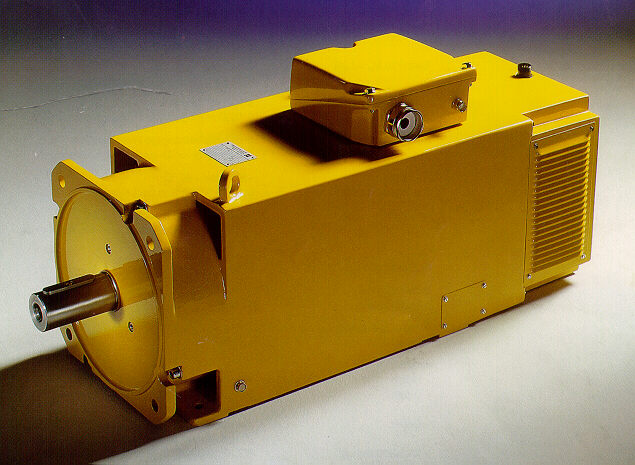
The rated output of the built Switched Reluctance Motor with 16 stator poles and 12 rotor teeth is 26 kW at 1500 rpm. In comparison with up to now produced Switched Reluctance Motors of equal motor size, the rated output could be increased to about 150%. The efficiency of the new drive system regarding dynamics, speed control and position control is proved with measuring results.
Overview
Project Manager: Jürgen Wolff
Lamination Optimizer: Eberhard Vonhof
Motor Manufacturer: Elbtalwerk GmbH
The rated output of the built Switched Reluctance Motor with 16 stator poles and 12 rotor teeth is 26 kW at 1500 rpm. In comparison with up to now produced Switched Reluctance Motors of equal motor size, the rated output could be inreased to about 150%. The efficiency of the new drive system regarding dynamics, speed control and position control is proved with measuring results.
Summary
The Electrical Institut of the University Karlsruhe has developed, optimized and manufactured a Switched Reluctance Drive with power converter and control engineering according to the latest scientific findings. The motor was constructed for the rated output of 26 kW and for industrial applications. The drive works in all for quadrants and was designed for applications with highest demands for dynamics, constant torque, low noise and highest power output. The nominal speed of the test Switched Reluctance Motor is 1500 revolutions per minute. Cooling is obtained using an external blower, which blows air over the machine (cooling method IC416). The motor was built for continuous running duty and for both turn directions. The degree of protection is IP 54. Table 1 lists the technical data of the new 16/12 Switched Reluctance Motors in comparison with another Switched Reluctance Motor. The main components of the test drive are the Switched Reluctance Motor and the power converter. The voltage-source converter consists of mains and motor converter. The common supply for the three-phase-self-commutated mains converter is 400V/50Hz.
| type: | CVEAA XM 132L |
MFR 132.5 University Karlsruhe |
comparison |
| rated output | 17 kW | 26 kW | improve to 152 % |
| nominal speed | 1500 rpm | 1500 rpm | equal |
| shaft height | 132 mm | 132 mm | equal |
| length | 985 mm | 777 mm | reduce to 79 % |
| weight | 178 kg | 165 kg | reduce to 93 % |
| duty type | S1 | S1 | equal |
| thermal class | H | H | equal |
| cooling method | IC 416 | IC 416 | equal |
| cooling fan | 250 W | 65 W | reduce to 26 % |
| moment of inertia | 0,0892 kgm2 | 0,0883 kgm2 | |
| number of phases | 3 | 4 | |
| stator poles | 12 | 16 | |
| rotor teeth | 8 | 12 |
Table 1: Technical data of the new 16/12 Switched Reluctance Motor in comparison with another Switched Reluctance Motor
Torque ripple
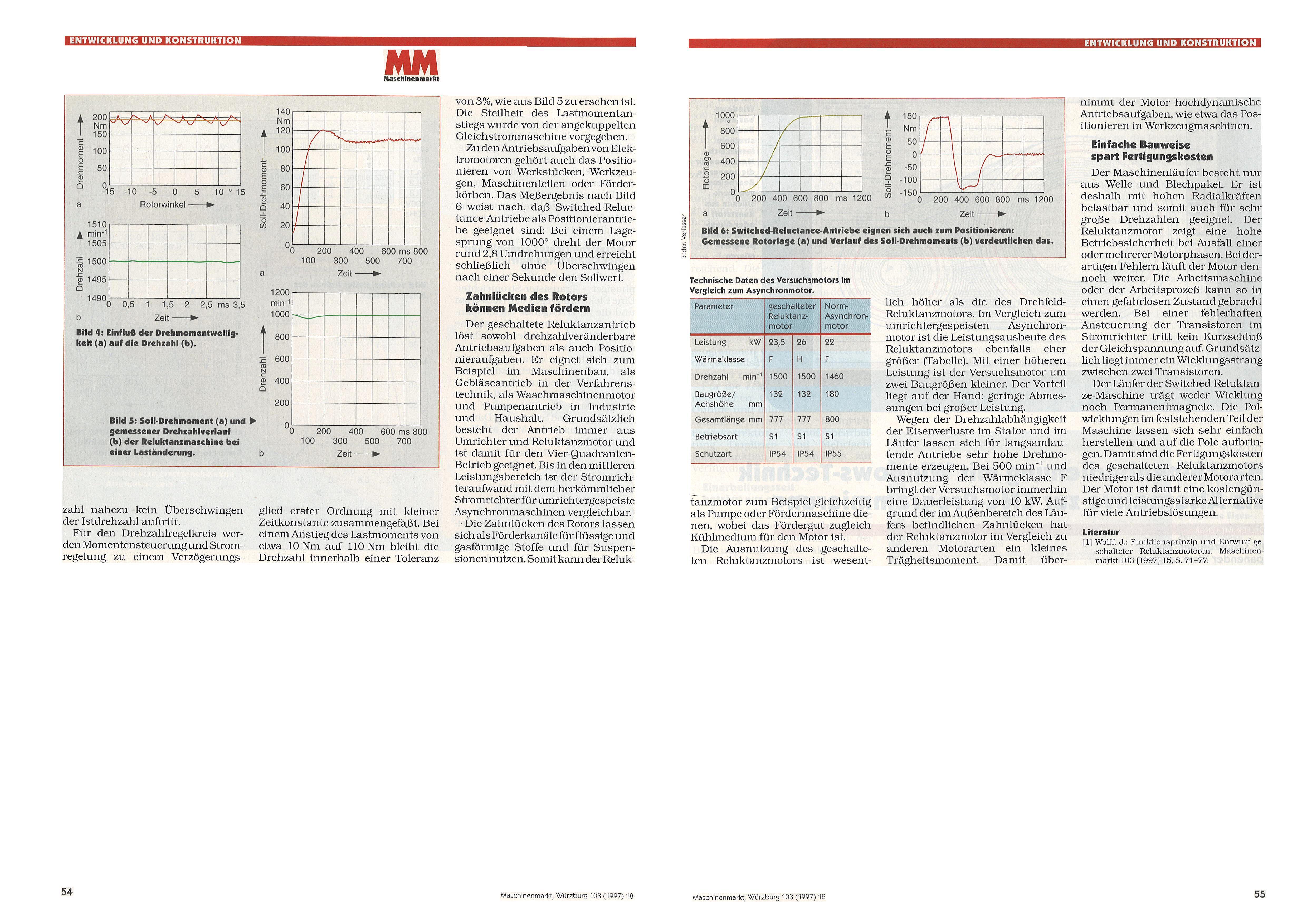
All converter-fed electric motors have a greater or lesser torque ripple on the generated main torque. An excessive torque ripple has limited the applications of Switched Reluctance Drives in servo systems. For these reasons we minimized this ripple with the motor model and the current control. The small torque ripple and its effect on the speed is shown in Figure 1. The torque ripple is smoothed only with the inertia moment of the Switched Reluctance Motor. In this simulation, the load inertia equals zero. Under these working conditions already, the speed is almost constant.
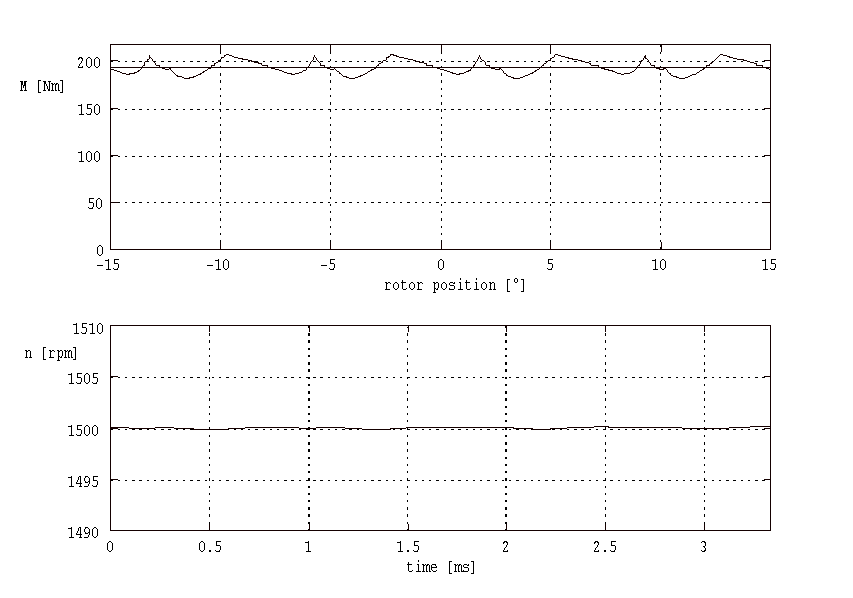
Figure 1: Torque ripple and its effect on the speed (simulation) J = 0,0883 kgm2
16/12 Switched Reluctance Motor and its speed control
The control has been optimized to minimize speed variations. The speed controller is a PI-controller. After a rated value jump of the speed, the measured speed does not swing over. The torque and current control are united in the speed control to a delay part of first order with a small time constant. After rise of the load torque by 100 Nm, the speed keeps within a tolerance band of 3 % (Figure 2).
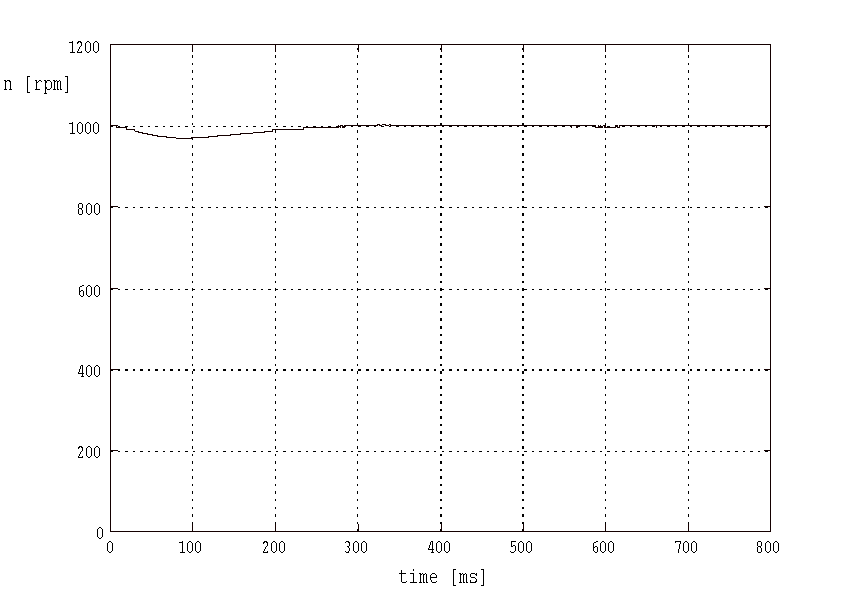
Figure 2: The speed after rise of the load torque by 100 Nm (measurement) J = 0,54 kgm2
16/12 Switched Reluctance Motor and its position control
Likewise, the position control of, for example, workpieces, tools, conveyor baskets etc. belongs to the applications of electric motors. The measuring result in Figure 3 proves that Switched Reluctance Motors with 16 stator poles and 12 rotor teeth are suitable position drives. After a rated value jump of 1000°, the motor performs about 2,8 turns and reaches the rated value without over swing in one second.
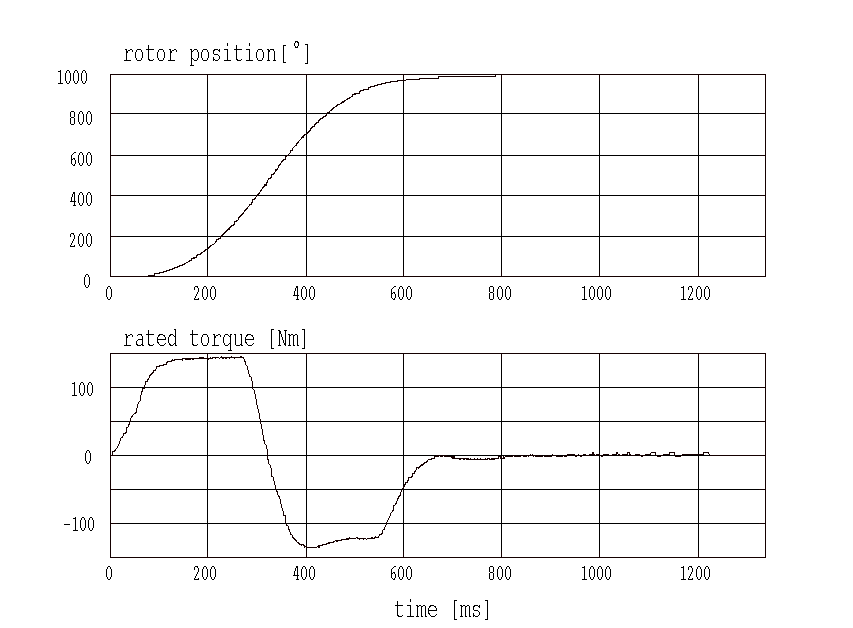
Figure 3: Position control (measurement) J = 0,54 kgm2
Mains friendliness of the Switched-Reluctance-Drive
The mains converter is a three-phase-self-commutated IGBT-Converter. The control of the mains current has been optimized in a way that the drive, in stationary running with a cos(=1 and with a power factor of about one, receives energy from or feeds energy into the threephase current mains. This results in a sinusoidal mains current and in conformity of the phase position between current and voltage - at long last the mains friendliness of the drive.
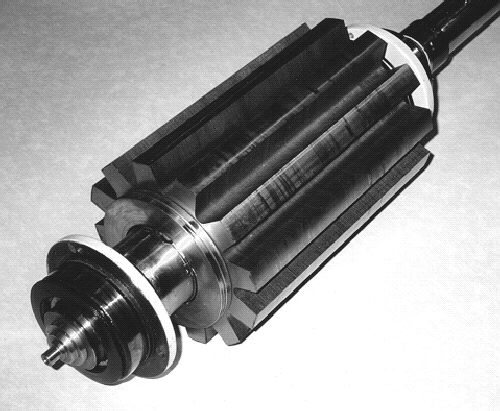
Rotor for the 16/12 Switched Reluctance Motor
Advantages
- above-average continuous torque in the base speed range
- extraordinary acceleration capability
- low maintenance
- high holding torque even over extended periods
- high overload capability
- small dimensions
- high operating safety after failure of one or several motor phases
- excellent efficiency over wide speed range
- ruggedness
- negligible rotor temperature rise
- maximum speeds: As the rotor of the switched reluctance motor has no winding and no permanent magnets, it may be subjected to high radial forces which makes the motor ideal for high-speed applications. Since the hysteresis loss rises as the speed increases, low-pole reluctance motors are the best choice for these applications.
Publications
Deutsch:
- Steiert, U.: Drehmomentsteuerung einer Reluktanzmaschine mit beidseitig ausgeprägten Polen und gringer Drehmomentwelligkeit. Dissertation am Elektrotechnischen Institut der Universität Karlsruhe 1992
- Späth, H.; Wolff, J.: Der elektrische Antrieb der Zukunft? -Der geschaltete Reluktanzmotor: oft die kostengünstigste und leistungsstärkste Lösung- TECHNICA (1996), H. 19, S. 49-53
- Wolff, J.: Gehört dem Reluktanzmotor die Zukunft? Konstruktion & Engineering (1997) 3, S. 18-19
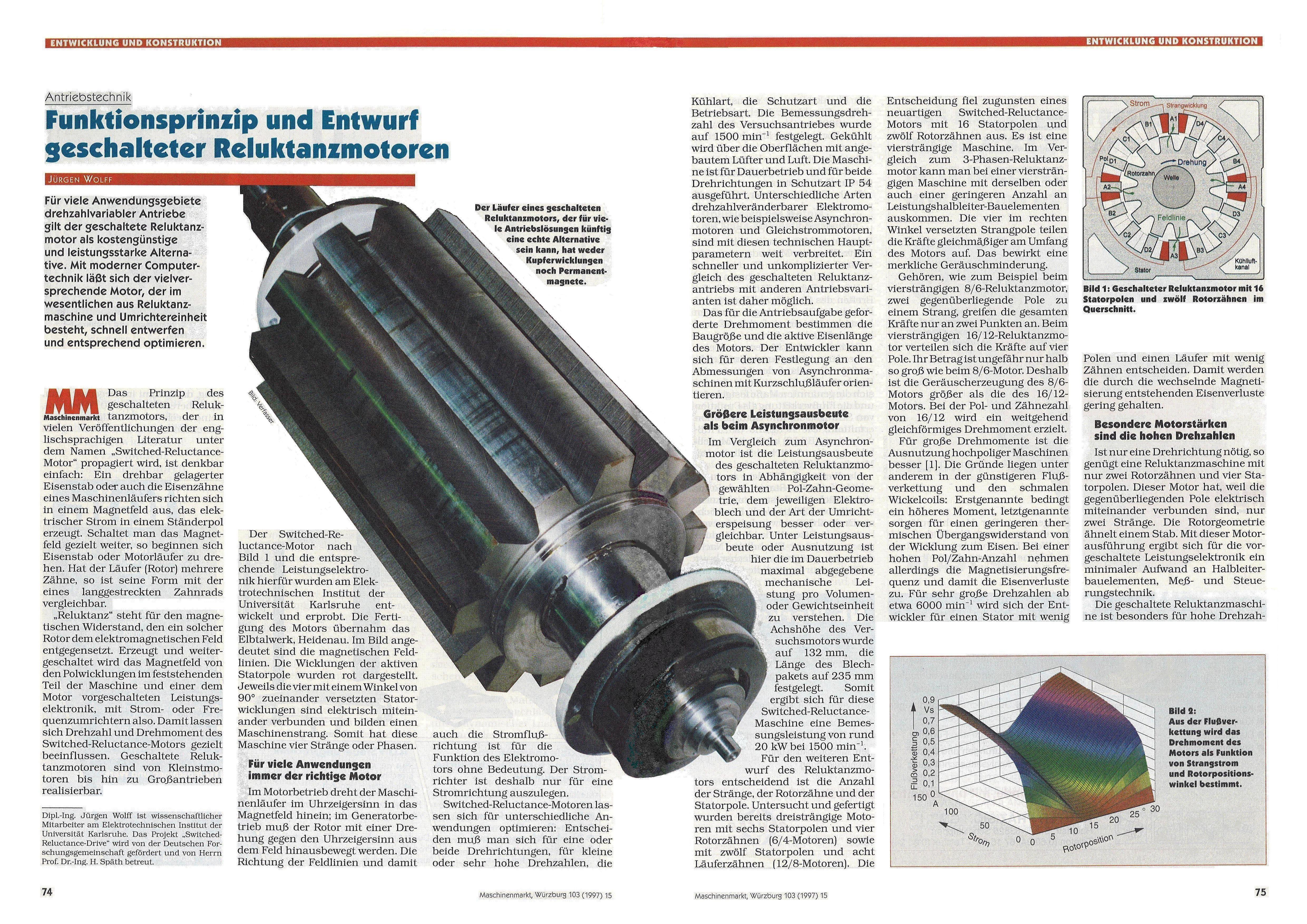
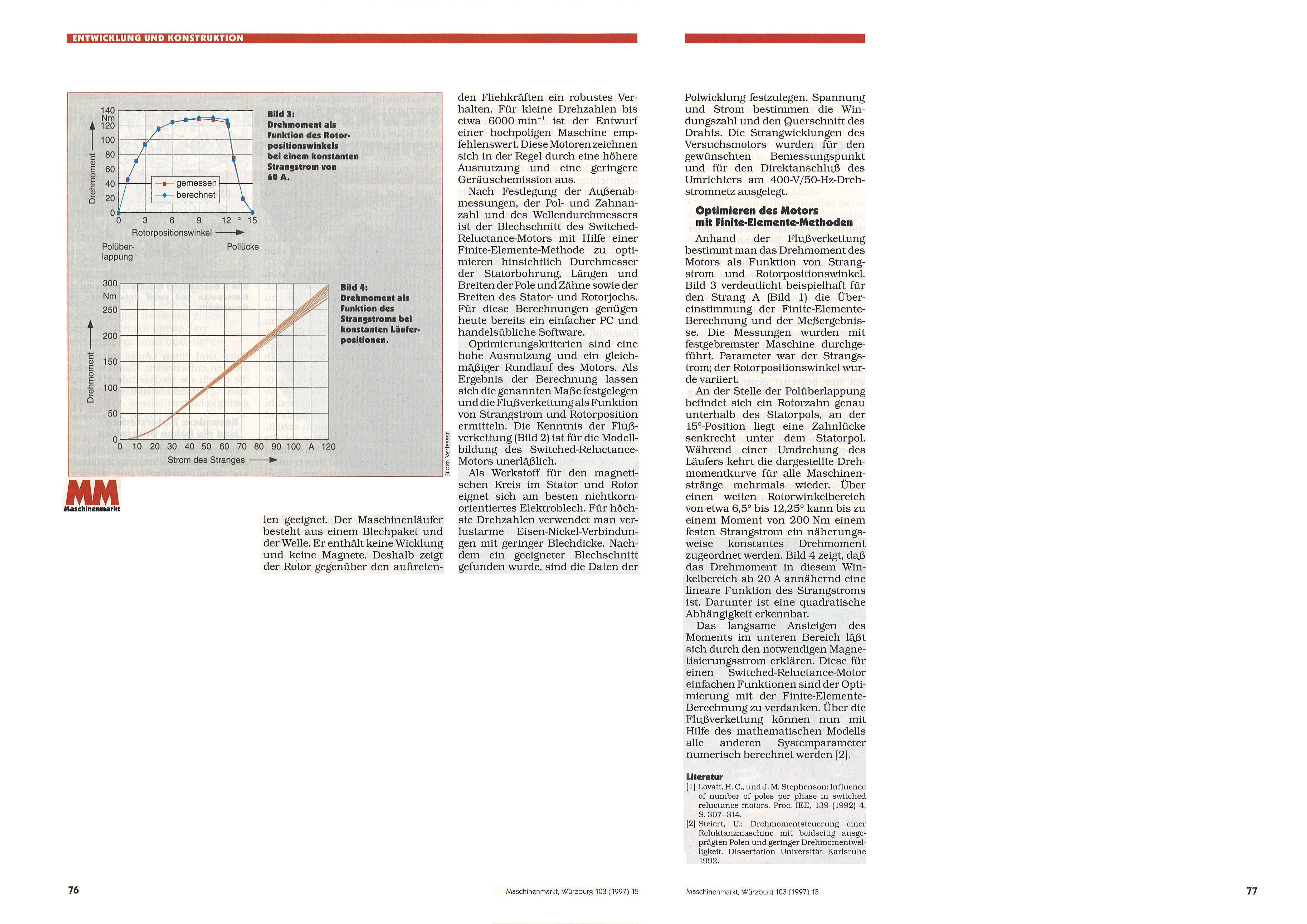
- Wolff, J.: Funktionsprinzip und Entwurf geschalteter Reluktanzmotoren. Maschinenmarkt 103 (1997) 15, S.74-77
(pdf-Datei 5.9MB) oder (jpg-Datei 4.5MB) und (jpg-Datei 1.4MB) - Wolff, J.: Geschalteter Reluktanzmotor - Drehmomentstarker Elektromotor mit kleinem Bauvolumen. (Messeprospekt anläßlich der Hannover Messe´97, Elbtalwerk Heidenau GmbH) (verfügbar als pdf-Datei 232kB)
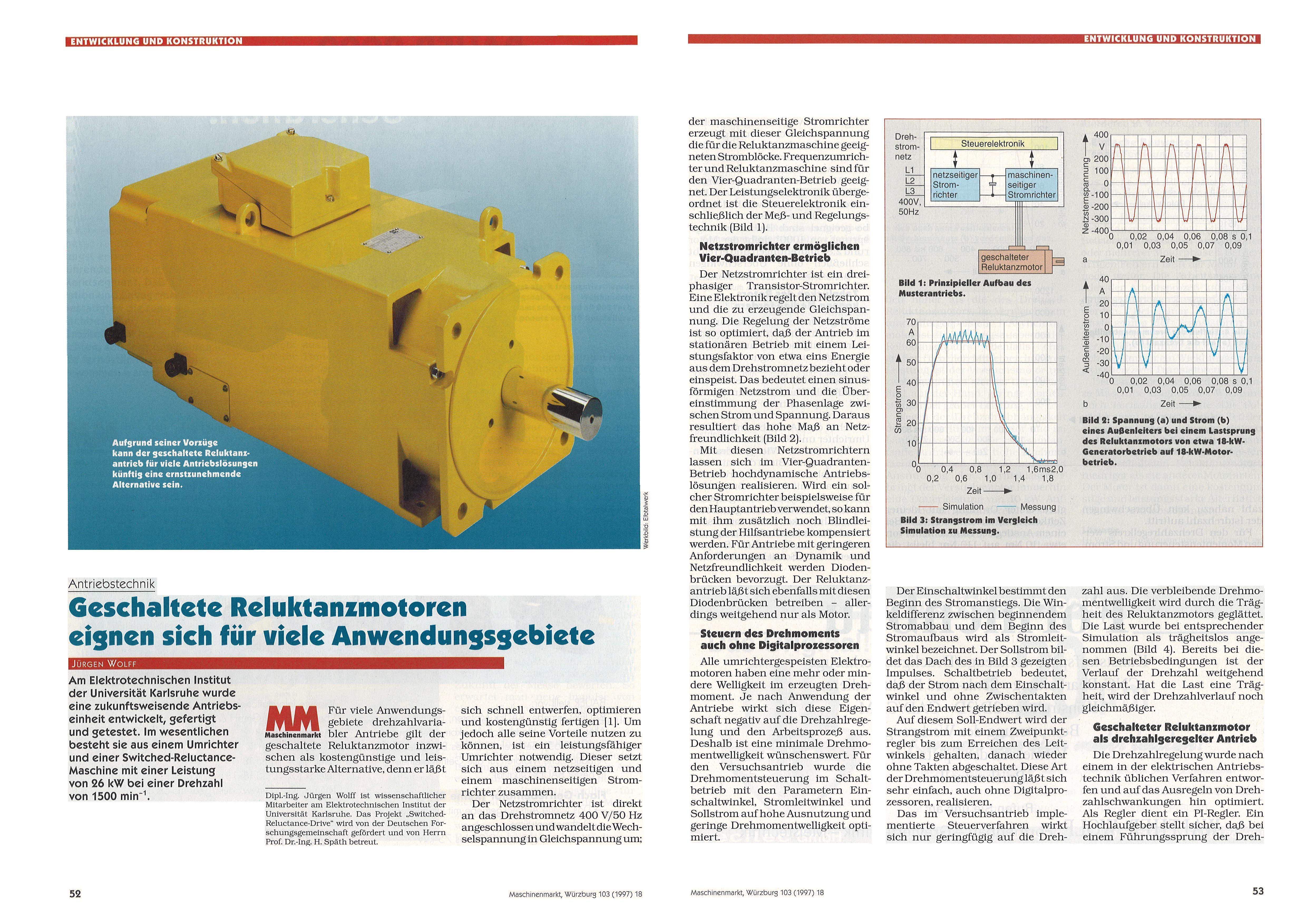
- Wolff, J.: Geschaltete Reluktanzmotoren eignen sich fuer viele Anwendungsgebiete. Maschinenmarkt 103 (1997) 18, S. 52-55
(pdf-Datei 4.2MB) oder (jpg-Datei 2.4MB) und (jpg-Datei 1.7MB) - Wolff, J.; Bauer G.; Simon O.: Netzfreundlicher Anschluß elektrischer Antriebe an das Drehstromnetz durch verbesserte Regelung. atp - Automatisierungstechnische Praxis (1997) 11 S. 44-51 (verfügbar als pdf-Datei 178kB)
- Wolff, J.: Drehzahlveränderbarer Industrieantrieb mit Geschaltetem Reluktanzmotor. Dissertation Universität Karlsruhe, 1999 (Die Arbeit kann im Buchhandel über den Verlag Mainz in Aachen bezogen werden. ISBN 3-89653-481-5)
- Wolff, J.; Späth, H.; Klaus, C.: Positionieraufgaben mit Geschaltetem Reluktanzantrieb. Konferenzband der Fachtagung Leistungselektronik und intelligente Bewegungssteuerungen, S. 143-148, Magdeburg 1999 (verfügbar als pdf-Datei 64kB)
- Wolff, J.; Neubert, Th.: Drehzahlveränderbare elektrische Antriebssysteme im Vergleich.
atp - Automatisierungstechnische Praxis (2002) 11 S. 52-60 (Abstrakt verfügbar pdf-Datei 53kB), (pdf-Datei 6.3MB) - Neubert, Th.; Wolff, J.; Helduser, S.; Späth, H.: Untersuchung elektrischer Antriebssysteme am Beispiel von Hydraulikpumpen. antriebstechnik 43 (2004) Nr. 1 S. 34-41 (verfügbar pdf-Datei 3.2MB)
English:
- Wolff, J.: Switched Reluctance Motor - Compact High-torque Electric Motor. (prospectus on the occasion of Hannover Messe´97, Elbtalwerk Heidenau GmbH) (pdf file available 165KB)
- Wolff, J.; Späth H.: Switched Reluctance Motor with 16 stator poles and 12 rotor teeth. Proceedings of 7th European Conference on Power Electronics and Applications, Vol. 3, p. 558-563, Trondheim 1997 (pdf file available 165KB)
- Wolff, J.; Rahner, R.; Späth, H.: Sensorless Speed Control of a Switched Reluctance Motor for Industrial Applications. Proceedings of Optimization of Electrical and Electronic Equipments, Vol. 2, p. 457-462, Brasov 1998 (pdf file available 334KB)
Espaniol:
- Wolff, J.; Gomez G.: El motor de reluctancia conmutado. Un motor eléctrico con gran par motor y poco volumen. energia (1997) 4, p. 113-115 (pdf file available 200KB)