
System-Level Simulation and Performance Optimization of a Medium-Voltage MMC
- chair:System-Level Simulation
- type:Bachelor-/Masterthesis
- time:01/2027
- tutor:
- Image:
- person in charge:
available
-
Background
The energy transition is one of the defining challenges of our time. At the Karlsruhe Institute of Technology (KIT) we are not just observing this transformation, we are helping to build the infrastructure that will enable it.
The High-Power Grid Lab is being developed as one of the world’s most powerful testbeds for modern power systems. Its goal is to recreate complex grid conditions and test large-scale generation units and converter-based systems before they are deployed in the field. By identifying instabilities, interaction effects and failure scenarios in a controlled laboratory environment, we help ensure the reliability, stability, and safety of the power grids of tomorrow.
The heart of this facility is a cutting-edge SiC-based Modular Multilevel Converter (MMC) for medium-voltage applications, developed here at ETI. We are looking for bright and driven minds who want to become part of the larger mission by building the technological foundation for the next generation of sustainable power grids.
One Model to Rule Them All!
The first MMC cell prototype is ready, but is it ready for the full converter? Your challenge is to uncover what limits the system's performance, under which conditions, and why.
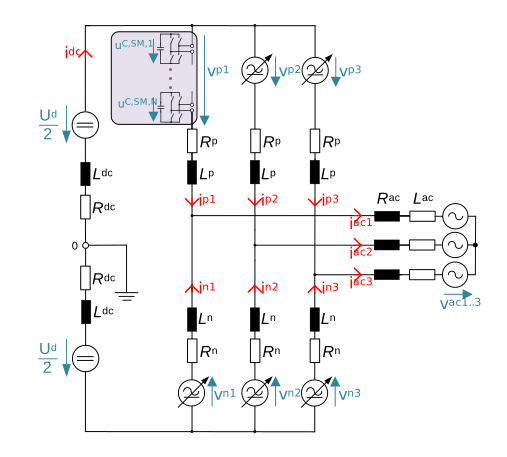
You will develop a comprehensive system-level simulation of the MMC, incorporating semiconductor losses, capacitor banks, arm and phase inductors, cables, and their parasitic effects. Your work includes dimensioning the arm and phase inductors to meet the system requirements and identifying potential resonances caused by parasitic elements in the electrical interconnections.
You will investigate how switching frequencies, control execution rates, communication delays, and cable characteristics affect the achievable control bandwidth and overall system performance. By exploring design alternatives and their trade-offs, you will identify potential improvements and determine whether the existing electrical and mechanical cell design can be retained or where targeted, high-impact modifications are worthwhile.